
Hale County Deed Types
In Hale County, the Probate Judge records deeds and mortgages. The judge also maintains the county Records Office. The label tells you what a deed should do. It does not settle validity or the quality of title. Read the granting language, signatures, legal description, reservations, and exhibits. Check any later filings before drawing conclusions.
| Deed Type | What It Does | Common Use |
|---|---|---|
| Warranty deed | Conveys the stated interest with deed warranties | Ordinary purchase or sale |
| Quitclaim deed | Conveys whatever interest the grantor may hold | Family or corrective transfer |
| Executor or administrator deed | Conveys through estate authority | Probate transfer |
| Tax or sheriff deed | Records a statutory-sale transfer | Delinquency or enforcement |
| Corrective deed | Repairs a stated flaw in an earlier filing | Name or legal-text correction |
Mortgages and easements often sit beside a deed. So do satisfactions, assignments, restrictions, and judgments. Search every instrument type in the same trail, and treat a tax deed with care, since redemption periods and prior encumbrances can block clear title.
Hale Probate Records Office
Judge David L. Parker's Probate Judge office keeps the recorded deeds, mortgages, plats, and other land records. They all serve Hale County. Visit the counter at 1001 Main Street, Greensboro, Alabama 36744, or call 334-624-8740. The staff handles certified copies, old deed books, plat questions, and confusing book series.
Fees shift, so ask first. Request the current search, copy, and certification charge before you order anything. State recordation taxes sit apart from local recording or copy fees. Both can apply to a single deed records request.
Open Hale Deed Records Online
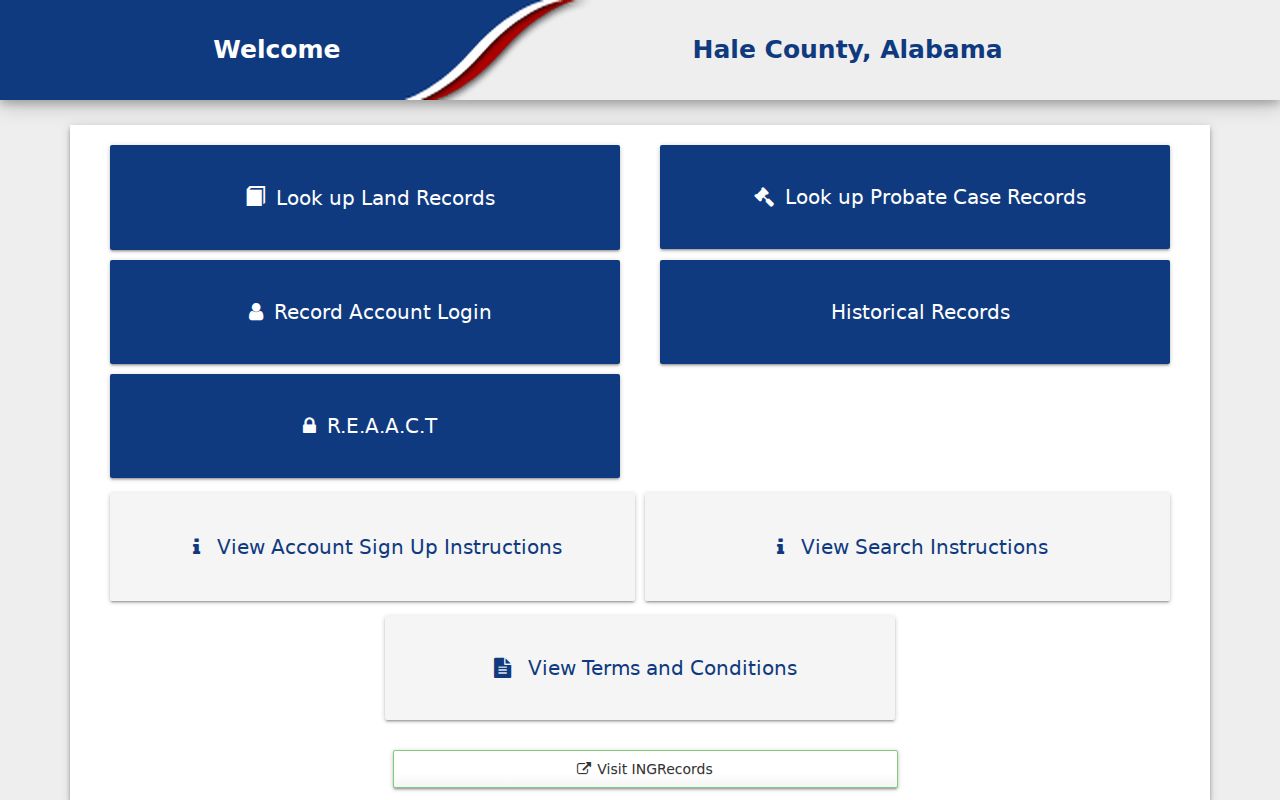
Hale County links to Hale Online Services. The portal covers land records, probate cases, historical records, R.E.A.C.T., instructions, and account help. After account setup, an index search routes document pages through an account or a pay-per-document cart. Check with the Probate Judge for current image pricing.
An index result is not the deed itself. Only the instrument image supplies deed-specific evidence, so open it before drawing conclusions. A downloaded image is not automatically certified. When you need a complete attachment, an official seal, or a certified copy, ask the Probate Judge.
Hale Land Index Controls
The online instructions cover search type, party terms, date range, book and page, role, Starts With, instrument type, result filters, sorting, and cross-references. Those controls matter. Hale County deed records go deeper than any owner list.
| Control | How to use it | What to verify |
|---|---|---|
| Party role | Choose Grantor, Grantee, Assignee, or all | Search both sides |
| Starts With | Test a leading name string | Repeat without it |
| Instrument type | Narrow deeds, mortgages, releases, or easements | Use several if needed |
| Book/page | Open a known reference | Keep zeroes and letters |
| Cross-reference | Follow a linked filing | Read later releases |
Portal terms bar automated scraping, so keep lookups manual. Keep a narrow evidence log with the query, date, parties, role, book and page, page count, cost, and download status.
Follow Hale Grantors and Grantees
A grantor conveys an interest. A grantee receives it. To work backward, start with the newest confirmed grantee, open that deed, and search the same party as grantee in an earlier period. To move forward, search a known owner as grantor and inspect everything recorded later.
- Find the present assessment owner and deed reference in CAMA or GIS.
- Search that name as grantee and open the likely acquisition deed.
- Read the grantor, legal description, and prior book/page from the image.
- Repeat with the prior owner, then move to books or microfilm when online coverage ends.
- Grantor
- The party conveying the stated interest.
- Grantee
- The party receiving the stated interest.
- Chain of title
- The linked sequence of recorded transfers for land.
- Book/page
- The recorded location used to retrieve an instrument.
Hale Book and Page Leads
Hale GIS carries deed references. A book number, page, and deed date sit beside the parcel ID and legal field. A Greensboro sample points to book 2016, page 606, yet map data can lag the newest conveyance. Confirm it in the land portal first. Then open the image and search both parties for later deeds, capturing execution and recording dates, deed type, consideration if stated, legal description, reservations, easements, exhibits, and prior references. Compare acreage to the parcel map. A parent tract often explains the difference.
Hale Plats Connect Deeds to Lots
Subdivision deeds often cite a plat. Georgetown lots 38 through 41 point to Plat Book 2, page 24, while Countyline examples cite MB 2, page 38-A. Pull the recorded plat from Probate before trusting a lot line.
When the plat is open, check the subdivision name, surveyor, date, approvals, lots, road widths, easements, common areas, rights-of-way, and any revisions. The Hale County parcel maps locate the tract. Deed records and the plat carry the recorded trail.
The 1935 Hale Records Fire
A fire on March 4, 1935 damaged the courthouse's top floor. Reports say vaults and removal saved many records. The exact series affected remains unresolved. Claim no blanket deed gap; ask instead whether deed indexes, mortgage books, plats, and probate files were preserved, rebuilt, or microfilmed.
For older work, search Alabama Secretary of State land records, which cover statehood through 1950. The ADAH microfilm catalog locates county series. Many originals stay with the office that created them.
Request a Hale County Deed
Find the deed online first. Search by party, date, or book and page, and check every page and cross-reference. If the image is missing, contact the Probate Judge by phone, visit, or letter with party names, instrument type, date range, book and page, and legal description. Ask about price and delivery for each copy type.
Recorded, not guaranteed. Hale County deed records show filed instruments, but they are not a title opinion and cannot rule out every unrecorded interest.
Alabama open-record law lets citizens inspect and copy public writings unless an exemption applies. Hale County fixes no copy rate or deadline. So state exactly what you need when you ask. A title professional or surveyor may still be necessary when priority, marketability, validity, or a boundary is disputed.
Search Hale Mortgages and Releases
A deed tells you who owns the land. It rarely tells the whole story. Beyond the ownership deed, Hale County property records can include mortgages and deeds of trust, assignments, releases, satisfactions, easements, rights-of-way, restrictive covenants, judgment liens, and tax liens. These all tie to the same parties and legal description. Use the instrument multi-select in the portal to narrow the field. Cross-references sometimes surface a later filing you would otherwise miss.
Work each mortgage carefully. Note the borrower, the lender, the amount if stated, the date, the book and page, and the legal description. Then track any assignment or release that follows. Never assume a loan is paid off just because it looks old. For an easement, identify which parcel benefits and which is burdened. Also note the route, width, purpose, maintenance terms, and any amendment. A road or rail line shown on a GIS map is only a locator. Find the instrument itself before relying on it.
A lawsuit in the chain changes the picture. The Hale Circuit Clerk keeps the public court files. These cover foreclosure, quiet title, partition, lis pendens, and lien enforcement actions. Remember that a complaint only makes allegations. Before you draw any title conclusion, look for the final order. Also find the recorded judgment, a release, or a later deed.
Hale Deed Search Quality Checks
Before closing the file, confirm that every transfer involves the same tract. Compare the full legal description and the subdivision and plat. Check the section-township-range, the acreage, and the adjoining calls. Names alone are weak proof. Common surnames, family transfers, estates, and entity names can easily lead you astray.
Keep execution dates and recording dates separate. Note whether each copy came from the portal, the courthouse counter, mail, or microfilm. Also note whether it was certified. Ask for a complete copy if an attachment or margin is cut off. Hale County deed records support solid conclusions only when every claim points back to the actual instrument. Every claim must point back to the actual instrument.