
Compare the Three Hale County Property Values
Purpose drives every value field. Assessment numbers exist for ad valorem taxation, a deed's recorded consideration documents one transfer on one date, and a current appraisal answers what the parcel might bring today.
| Value | What It Is | Where |
|---|---|---|
| Appraised or market value | The assessor's full-value estimate for the roll | Hale Tax Assessor record |
| Classified assessed value | Appraised value multiplied by Alabama's class ratio | Assessment record |
| Recorded consideration | The amount stated for a particular conveyance, when shown | Recorded deed or transfer instrument |
| Land and improvements | Components behind a total assessment field | Assessor and Hale GIS value fields |
Alabama DOR sets a formula. Appraised value multiplied by the classification ratio yields assessed value, while millage and exemptions act later in the calculation. A tax bill is therefore a tax outcome, not a property value to substitute into a comparison.
Apply Alabama's Formula to a Hale Assessed Value
Alabama sorts property into classes. Each class carries a different ratio, so like must be compared with like. Class II is assessed at 20 percent of appraised value. Class III sits at 10 percent. Class I and IV use 30 and 15 percent. Know the class before comparing two assessment figures.
The official Alabama property-tax assessment guide separates appraisal, classification, millage, and exemptions. That makes it a sound reference for the formula. For the parcel's actual class and tax-year fields, rely on the Hale County assessor.
Interpret Hale GIS Value Fields, Not Their Labels Alone
The public parcel service exposes value fields. TOTALVALUE sits beside land, improvement, tax, owner, deed, and legal-description attributes in the official Hale parcel-layer schema, which documents every source field. That value is an assessment attribute. It is not a recorded sale price.
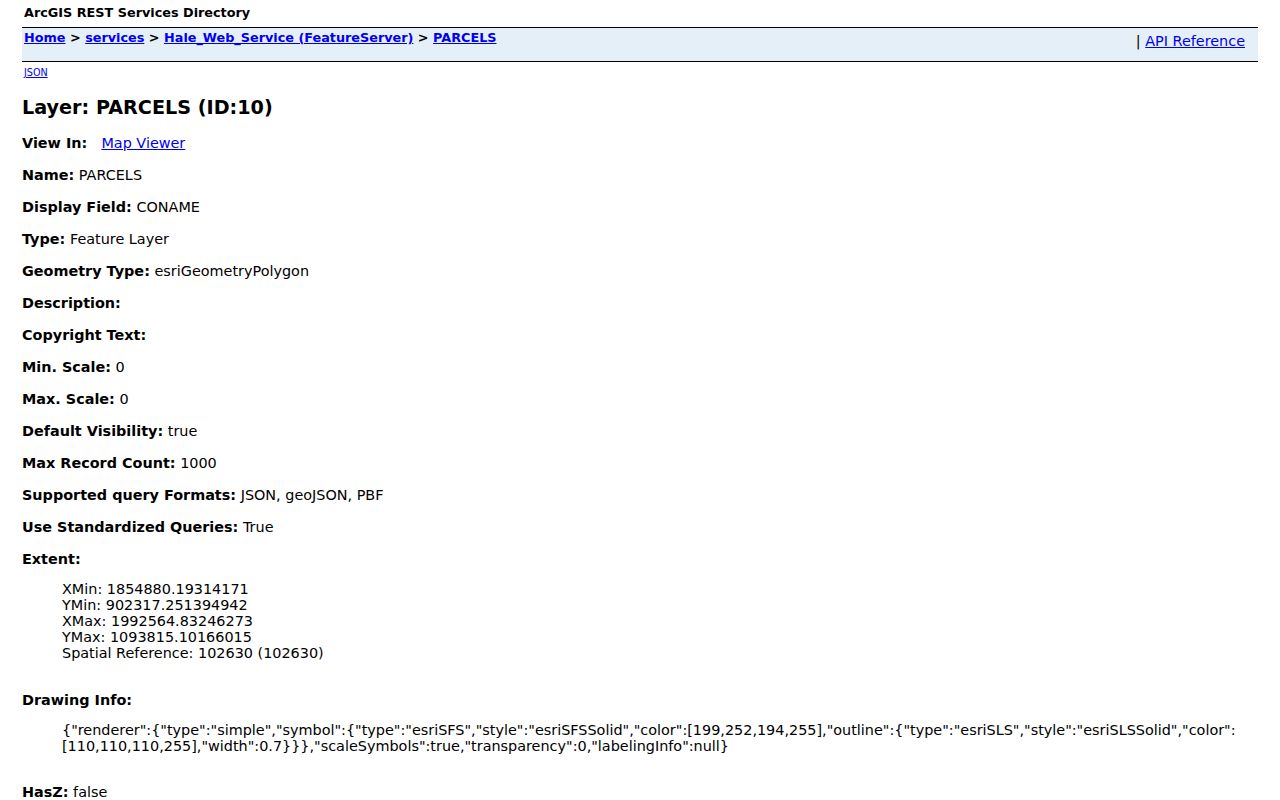
Those labels alone will not settle the question. Only the assessor can explain how the current tax roll treats a specific Hale County parcel.
Estimate the Meaning of a Hale County Value Record
Begin at the DOR-linked Hale Citizen Access Portal. Field order there can shift, so search conservatively and keep every parcel identifier handy.
- Locate the parcel by address, owner, parcel or PPIN, account, or map.
- Record tax year, class, appraised or market value, assessed value, and land/improvement split exactly as labeled.
- Confirm uncertain fields with the assessor rather than applying a guessed ratio.
- Search the latest deed for recorded consideration and its transfer date.
- Keep that historic consideration separate from the current assessment estimate.
- Assessed value
- The classified value to which millage is applied.
- Market or appraised value
- The assessor's full-value estimate for the roll.
- Assessment ratio
- The percentage set by the property's Alabama class.
- Sale consideration
- The amount associated with one recorded transfer, when stated.
- Reassessment
- A later official valuation of the parcel for assessment purposes.
Read Hale's 7 Percent Cap With Its Exceptions
Alabama's 2024 Act 344 caps annual taxable assessed-value increases at 7 percent. The cap covers Class II and Class III property. The cap has exceptions. Ownership changes, additions, improvements, and other statutory events can break through it.
The DOR cap guidance is the current state source. A capped taxable figure is not a statement of what the parcel would sell for.
Keep Hale Exemptions and Current Use in Context
Homestead and current-use treatment can change the taxable path without touching the sale consideration recorded in a deed. DOR defines a homestead as an owner-occupied single-family residence. Local application windows run January 2 through April 1. Current-use valuation applies a statutory, use-based approach to eligible land. Rollback can follow a qualifying change. These rules explain why similar acreage carries different taxable figures, yet none of it supplies a market appraisal for Hale County parcels.
Ask Hale's Assessor Which Value the Record Means
Portals do not always explain themselves. When a Hale County field is unclear, call the Tax Assessor at 334-624-3854 or the appraisal staff at 334-624-0705. The office sits in Room 3 at 1001 Main Street in Greensboro. Have the parcel ID, the property address, and the tax year ready before you dial.
Then ask the staff directly what the figure represents. Hale County property records can label a number as appraised, classified assessed, land only, improvement, or taxable, and each one means something different. For the recorded transfer amount, turn instead to Hale Online Services or call the Probate Judge Records Office at 334-624-8740. The deed record there shows what actually changed hands.
Compare Hale Property Value Records by Date and Purpose
Build a short worksheet instead of trusting memory. Give the assessor's appraised value one row, and add rows for classified assessed value, land and improvement components, and recorded consideration. Note the tax year or transfer date, the source, the parcel ID, and the exact field label for each entry. That discipline keeps a GIS figure from being mistaken for a sale.
A year-to-year change can have many causes. Reassessment, construction, or demolition may lie behind it. So can a classification change, a parcel split or combine, exemption treatment, current-use treatment, or an ownership event that triggers a cap exception. The number alone never identifies the cause. Ask Hale County appraisal staff which event and year the roll records.
Recorded consideration needs context too. A quitclaim, estate distribution, foreclosure, family transfer, partial interest, or multi-parcel conveyance may not resemble an open-market sale at all. Read the instrument's legal description and terms rather than lifting one amount from an index.
Matching parcels takes care as well. Confirm that class, acreage, improvements, tax year, municipality, and record source all line up before comparing anything. Hale County's 2025 millage schedule lists differing municipal components. Millage explains tax calculation after assessment. It does not make one parcel worth more in the market.
Keep Hale Sale Consideration in Its Own Column
A deed may state its consideration. That figure belongs to one conveyance on one date. Check whether the instrument covers multiple parcels, a partial interest, an estate, a correction, or another nonstandard transfer. Do that before setting it beside an assessed value.
Alabama's deed recordation tax is not an assessor valuation either. DOR lists that tax at fifty cents per five hundred dollars of value or fraction. Reverse-engineering the computation into a promised sale price is a mistake. Read the deed and its context first. The amount only means what the instrument says it means.
What a Hale County Property Value Does Not Prove
An assessment is a mass-appraisal record built for taxation. It promises no sale price, establishes no condition, lists no private restrictions, and replaces no appraisal prepared for a present purpose.
Value is not price. A Hale assessed value is for taxation and is not what the property will sell for. It is not an appraisal for a transaction.
The 2025 Hale millage table matters only after assessed value is understood. It is a tax-rate source. It is not a parcel valuation. For tax bills, exemptions, and appeals, see the Hale property tax records page.